Why product designers are good at creating design systems
What is a design system?
It refers to all activities that streamline and unify the product development process from a design perspective, and the system and work created as a result. From the work of systematically unifying colors and typography, to the work of templateizing a specific screen as a whole, I even think that even the ‘final final .psd’ that I created several times as a designer is part of the system.
In the process of materializing a service, a product designer must know how to draw the necessary screens and deliver them to customers. Rather than just drawing up design proposals and performing design QA once per product, we must continuously strive to discover and provide what customers need within the same product.
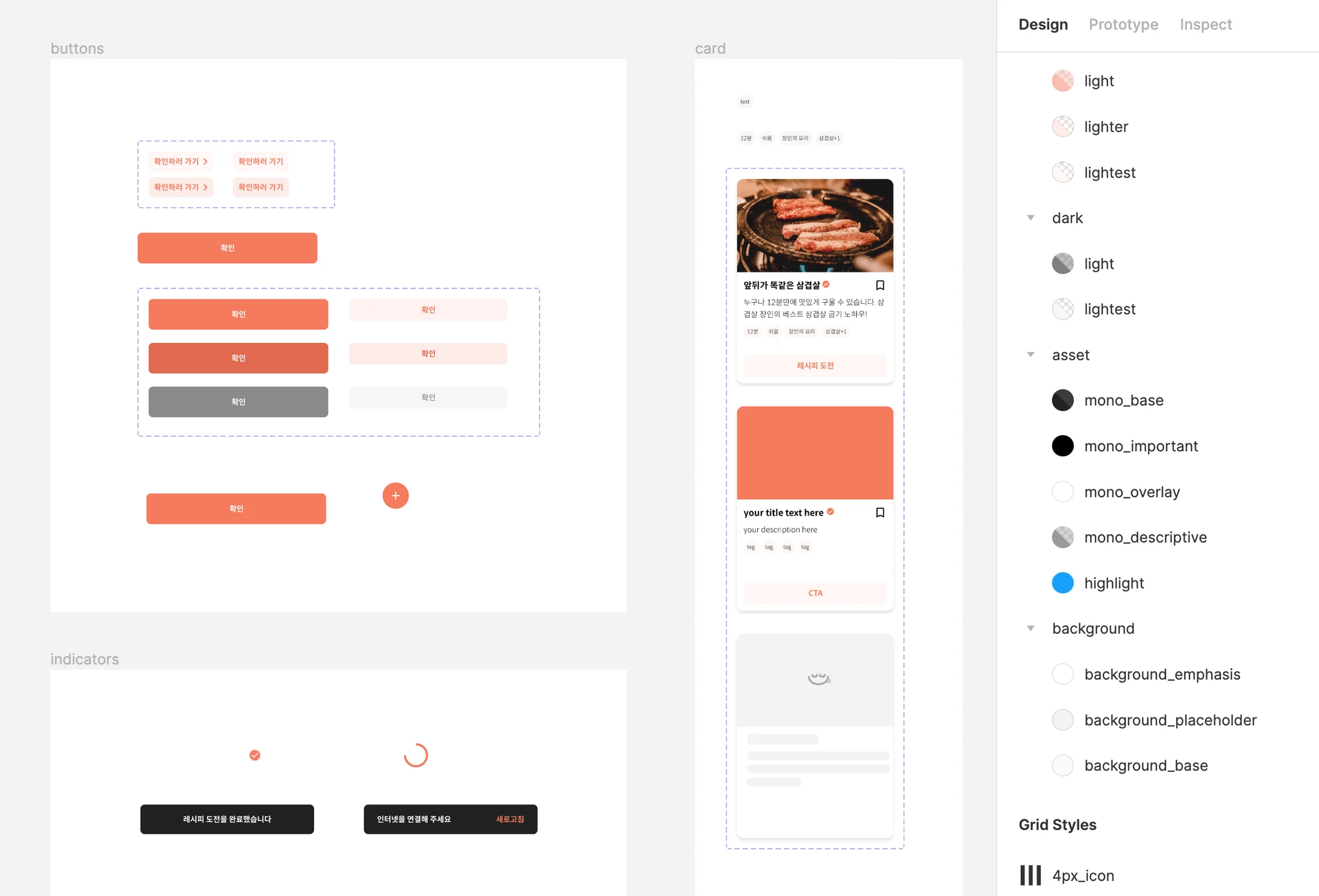
To make this faster, designers must be able to repeatedly use buttons they have already created, and also think about efficient ways to apply them to products as quickly as possible when there are changes to the button itself or brand strategy. The concept of ‘design system’ is a concept designed to systematically and efficiently manage repetitive design elements.
Why you need a design system
Many digital services in this world speak to users and customers in various ways. As a product designer, I think there are three main perspectives on expressing how a service is intended to be delivered.
1. A ‘product story’ perspective that can solve the needs of users and customers
This is generally the perspective of defining a problem that a product designer must solve. It includes the entire process of understanding who the customers who will use our product and how they use it, proposing a product flow that considers this together with a business perspective, and developing and delivering it to customers as the team intended.
2. A ‘branding’ perspective that conveys multiple product stories with one voice
Branding occurs at every point of contact between customers and brands. If the tone of branding is different for services with various product stories, it will be difficult for customers to feel like they are using the same service, and if this worsens, it can also affect brand credibility.
3. An ‘efficiency’ perspective that delivers more diverse and active product stories
We don't know which products will be successful. Just trying to make the best choice with limited resources. If the visual language of the various products that have already been tried can be systematized and utilized efficiently, designers will be able to get off work faster and the company will be able to quickly try out more products.
Product designers who design digital products generally consider perspective 1 to be the most important, but as the product becomes more sophisticated, the importance of perspectives 2 and 3 also increases. Therefore, we need to be able to look at design work from a branding and efficiency perspective, narrowly so that the designer ‘future me’ can leave work quickly, and broadly so that the entire organization can effectively convey a consistent voice. In this context, I believe that investing in upgrading the design system from the beginning will be helpful to both the organization and the designers.
Data driven, business driven
As explained above, as a product designer, it is important to think in terms of the product story. To summarize this further:
What / to whom / how / why / when can you convey it?
It may seem like it can be explained as follows, but in fact, this information may feel difficult to grasp. This is because most of the information is not processed for designers. Fortunately, 2022 is a digital world, and as work environments that value data become more common, it becomes easier to find more meaningful information and make decisions based on it. It will also be important for product designers to actively obtain information about data and business and try to utilize it when creating better products.
But how do we get this information? There are a variety of data collection tools out there, such as GA, Amplitude, and Google Forms, and your company may already have colleagues who are more specialized in the business or data area and have documents they have already created. It's a good idea to search for related conversation history on company messengers, and it's also a good idea to actively collaborate with these people when designing a product and get the information you need for your design. This information should be applied to the purpose of the project and expressed in the product based on the designer's expertise.
The same goes for design systems. Efforts will be needed to understand the behavioral data, feedback, and needs of various occupations that are considered customers (sometimes you may be a customer yourself) and to roughly measure the utility that these customers can obtain through the design system. If you can convince the organization that a project that required three people to do all night long can be done by one person in three hours after introducing the system, the organization will judge that it will be of great help to long-term business progress, and it will be easier to get the company's support needed for the design system to proceed with this.
