Overview · The invitation was part of the wedding, too
When we started planning our wedding, inviting people felt just as important as the day itself. There were introductions to make between our families, old friends to tell, and colleagues overseas to invite. We were sharing the same news, but what we needed to prepare changed with each person and each occasion.
We approached it as a project we would make together. We built a website, hosted an invitation party, and made a film of the experience. We relied on the venue and vendors where it made sense. Where we could make our own decisions, we wanted those choices to reflect both our tastes and our care for the people we were inviting.
Situation · Planning it together
The full preparation took about four months. We looked at more than ten venues, including discounts for dates still available at short notice, to find the quality we wanted at a price we could manage. We let go of our first-choice date and found a space we liked within our budget. By the time we signed, we had a little over three months until the wedding.
I built and ran the website and its admin tools, and handled the film editing and final rendering. Jieun compared vendors, offers, and costs, while also shaping the visual direction of the photos, website, and film. It wasn't a process where I made everything and she simply approved it. We kept deciding together what to show and how to show it.
A shared FigJam board, before and after the photo shoot
The studio shoot was a significant investment of time and money. Rather than make every decision on the day, we wanted to talk beforehand about the photographs we hoped to have. We gathered references in FigJam and worked through outfit combinations, makeup, hairstyles, and ideas for the shoot.
Afterward, we used the same board to review the results. We laid out the originals and retouched versions, chose our favorites, and discussed what needed another adjustment. Seeing the options together was much easier than sending individual photos back and forth.
Problem · Sharing the news without creating an obligation
Handing someone a wedding invitation can be delicate. In Korea, guests commonly give money to the couple, so I worried an invitation might sound like a request for a gift. But not telling someone could hurt, too, especially if they considered us close.
I wanted to share the news widely while leaving people free to decide whether to come. For those we couldn't meet, we could send a digital invitation. When we did meet in person, I wanted more than an exchange of envelopes: a chance to catch up and introduce the person each of us had chosen to marry.
Once we grouped the people we wanted to see and started working through dates, the list exceeded 100. Meeting everyone separately in three months wasn't realistic. Our parents, old friends, and people who knew only one of us also needed different kinds of context. One way of inviting people wasn't going to work for everyone.
Solution · A website, an invitation party, and a film
The website · We shared the invitation before the wedding photos were ready
We started by looking at existing digital invitation services. But they didn't give us the control we wanted over the URL and layout, or a satisfying way to review and use RSVPs and guestbook entries together. We also wanted to keep managing our photos and stories after the wedding. So we decided to build our own site.
The hardest decisions were about the order of information and how we wanted to introduce ourselves. Guests needed to find the date and venue easily, while the photos and stories could give them a sense of who we were. Jieun and I worked through the visual direction together, and I built the site with help from AI.
Our wedding photos weren't ready when we began sharing the invitation. Instead of waiting, we used a photo from a trip to Prague as the main image. As the studio photographs arrived, we chose them together and added them gradually. We started meeting friends before the full set was ready, too.
Even after we had the new photos, we kept the Prague image at the top. It captured something familiar about us: traveling, trying things, and spending time together. At first, we had chosen it because the wedding photos didn't exist yet. We kept it because it felt like us.
I made an illustration of us in the same pose, then connected it to the real photograph as guests scrolled. The practical details and other photos followed. Alongside the studio pictures, we used a Polaroid-like treatment to bring in some of the atmosphere we liked.
We wanted music to begin as the invitation opened. Browsers wouldn't let us start it without a visitor's click. Rather than add a separate play button, we made the seal on the envelope the trigger: tap it, and the invitation opens with the music.
As invitations went out, we added what we needed to run things. I built an admin view for RSVPs and guest information, prepared an English version for friends and colleagues overseas, and made separate pages for gatherings at our home and the larger party.
I didn't want the gallery to stop at the photos we had chosen. Our friends had memories of us on their phones, too. We let guests add photos and messages so they could contribute to the record. As the wedding approached, practical needs changed, and the site changed with them, including more detailed directions to the venue.
The invitation party · Bringing several circles of friends into one room
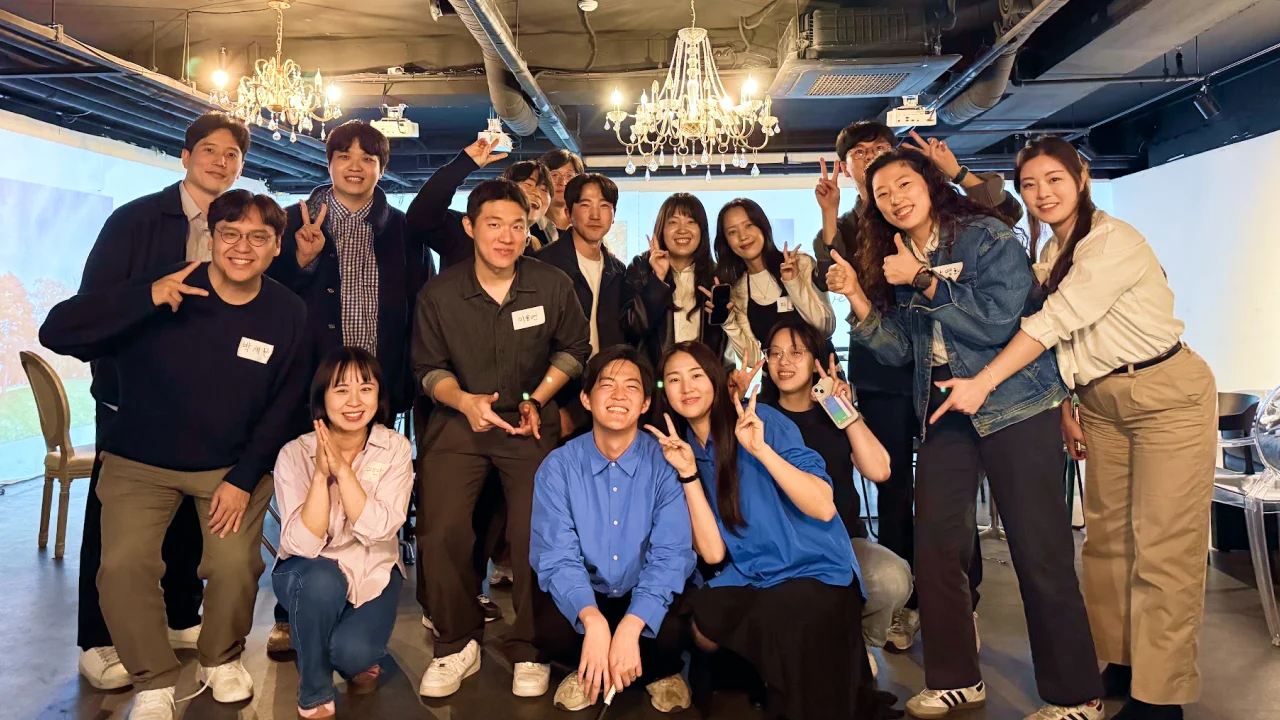
We decided to host a party for around 50 people, bringing several groups of friends together. We still kept the smaller gatherings we had already arranged, and met people individually when that felt more appropriate. The party wasn't a replacement for every invitation meeting.
A slide deck helped us answer the questions that came up repeatedly. We described each other in a few words and explained why, told the story of how we met and why we wanted to marry, and shared where we were in the preparations and what kind of life we hoped to build.
We adapted the same material for the formal meeting between our families and for smaller gatherings. For our parents, we added family introductions and more about how each of us had grown up. With friends, we could look through it together on a phone. For people we couldn't meet, we sent a link.
For the party, we rented an entire wine bar and projected the slides onto a wall. We added the evening's schedule, a quiz, and a backdrop slide for group photos. The story stayed the same, but the presentation changed to suit the occasion.
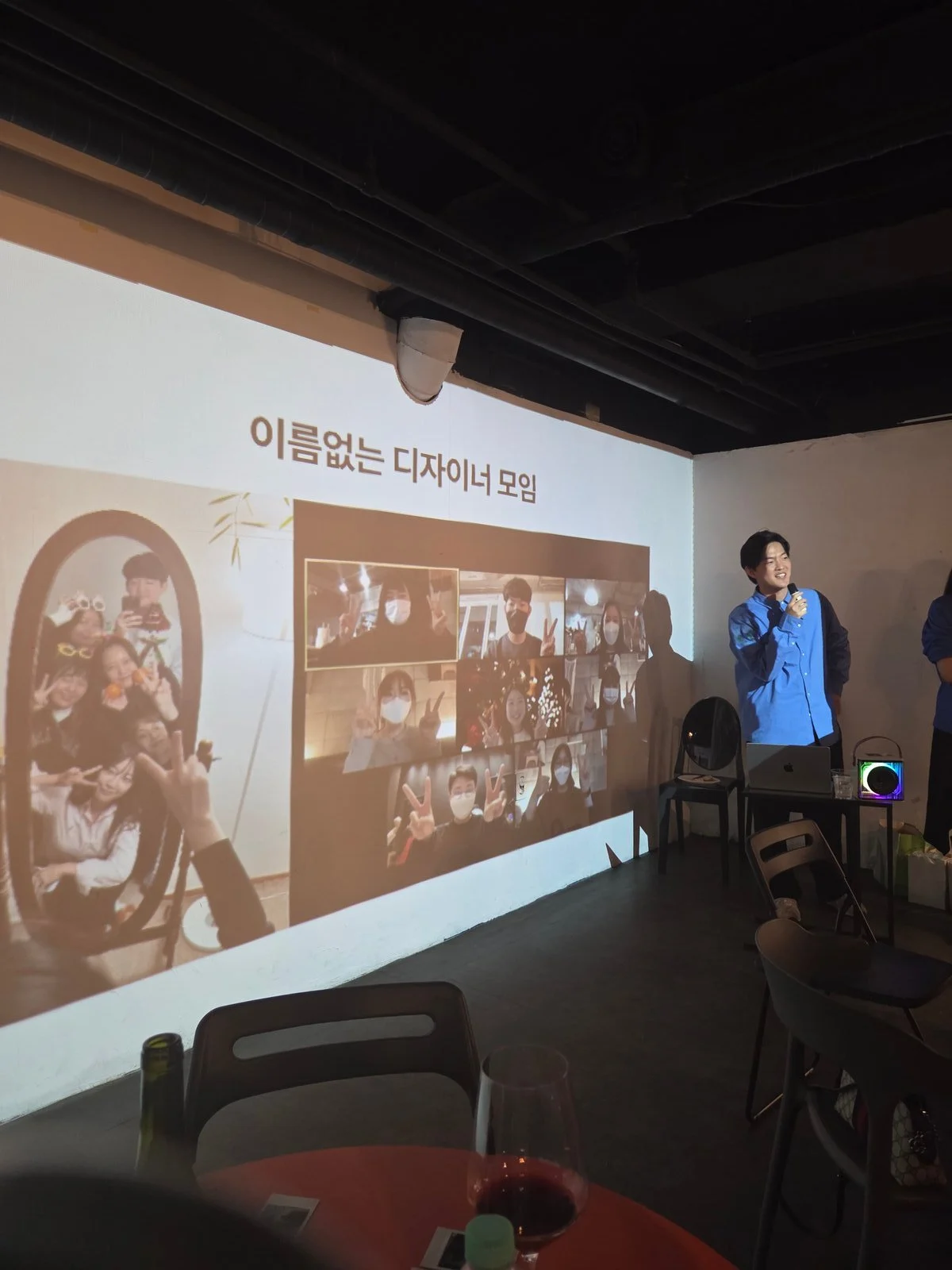
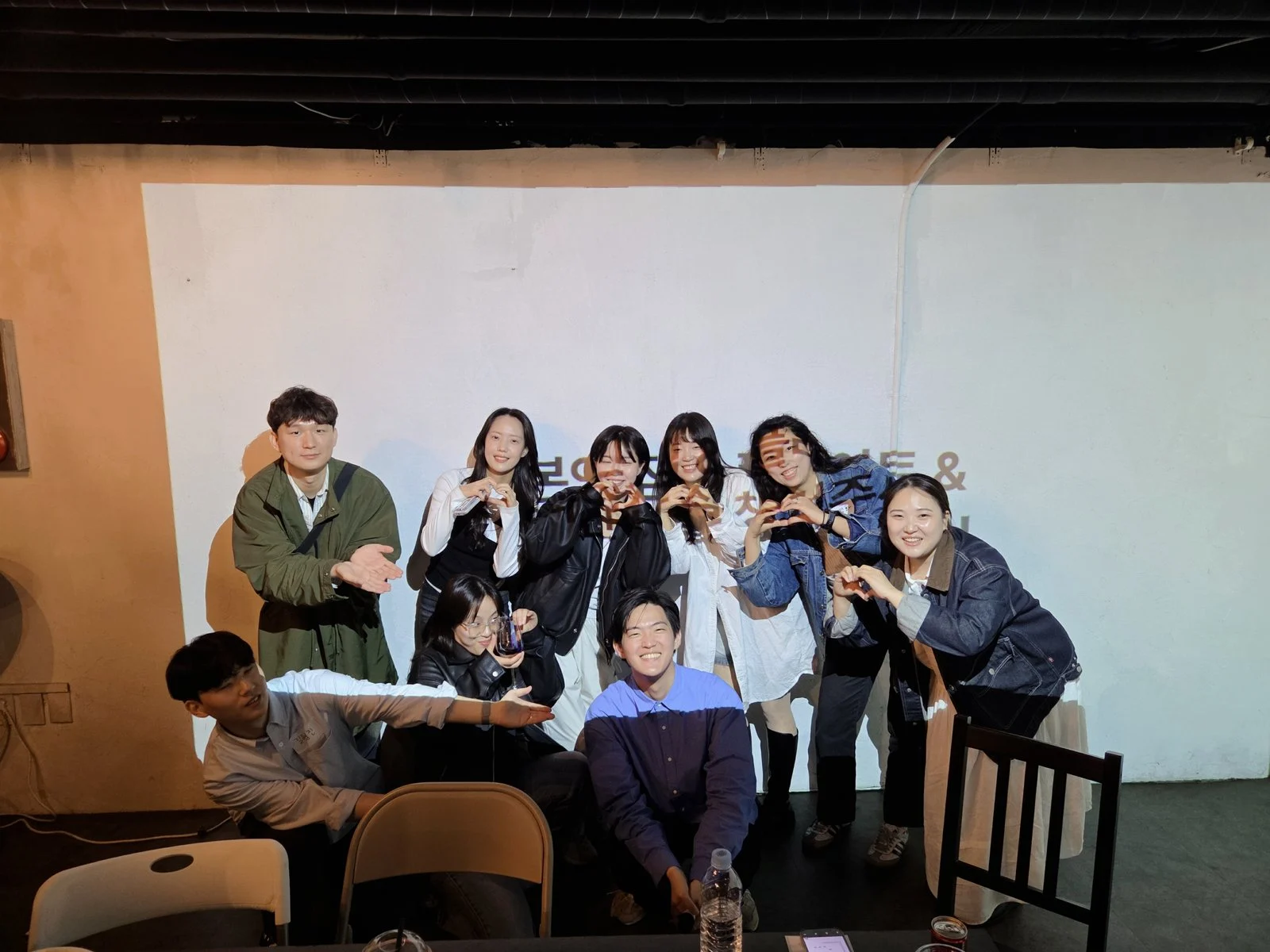
We didn't seat strangers together straight away. For the first half, we arranged seats around 11 existing groups so friends who rarely saw one another could catch up. In the second half, we mixed the tables and asked quiz questions about the story we'd just told. People worked out answers together, and everyone at a table that answered correctly received a gift.
Jieun made the quiz more fun and used discounts available through her workplace to find gifts within our budget. Her judgment mattered on the night, too. We had set out a guestbook and a Polaroid camera, but the first guests simply wrote their names in a column, as they might at a wedding reception desk.
Jieun opened a fresh page, wrote a casual note, and added a photo. After that, other guests began leaving messages and pictures. Providing the materials hadn't been enough to explain the kind of participation we hoped for. People needed to see someone go first.
The film · Including the people we met along the way
At first, the film was going to be a short account of how we met and decided to marry. But as we kept meeting people to invite them, I wanted to capture that process as well. The wedding was giving us a reason to reconnect and make new memories. We included moments of handing over invitations and scenes from our gatherings.
I edited the family meeting, photo shoot, smaller gatherings, and party into about four minutes, handling the final render and refining the film with Jieun's feedback. The website and gatherings had helped us invite people. The film would let us look back on that time together, in one room.
On the wedding day, I took the microphone, introduced the film, and watched it with our guests as a small shared screening. It also gave our parents' guests, many of whom didn't know us well, a chance to see who we were and how we'd arrived at that day.
We sent the link to people who couldn't attend. That let us share more than the announcement: they could see the preparation and get a feel for the wedding itself.
Solution · The time our guests spent with us
The venue was reasonably priced and gave us room to make the ceremony our own. The reception lobby and ceremony space were on separate floors, which made it easy to greet people before the wedding began. There was a large screen, room to display photos, and a staircase we could use for our entrance.
There was also a cafe-like space where guests could wait with a welcome drink, or stay and talk afterward. We wanted the time around the ceremony to feel comfortable, too: arriving, waiting, and saying hello to one another.
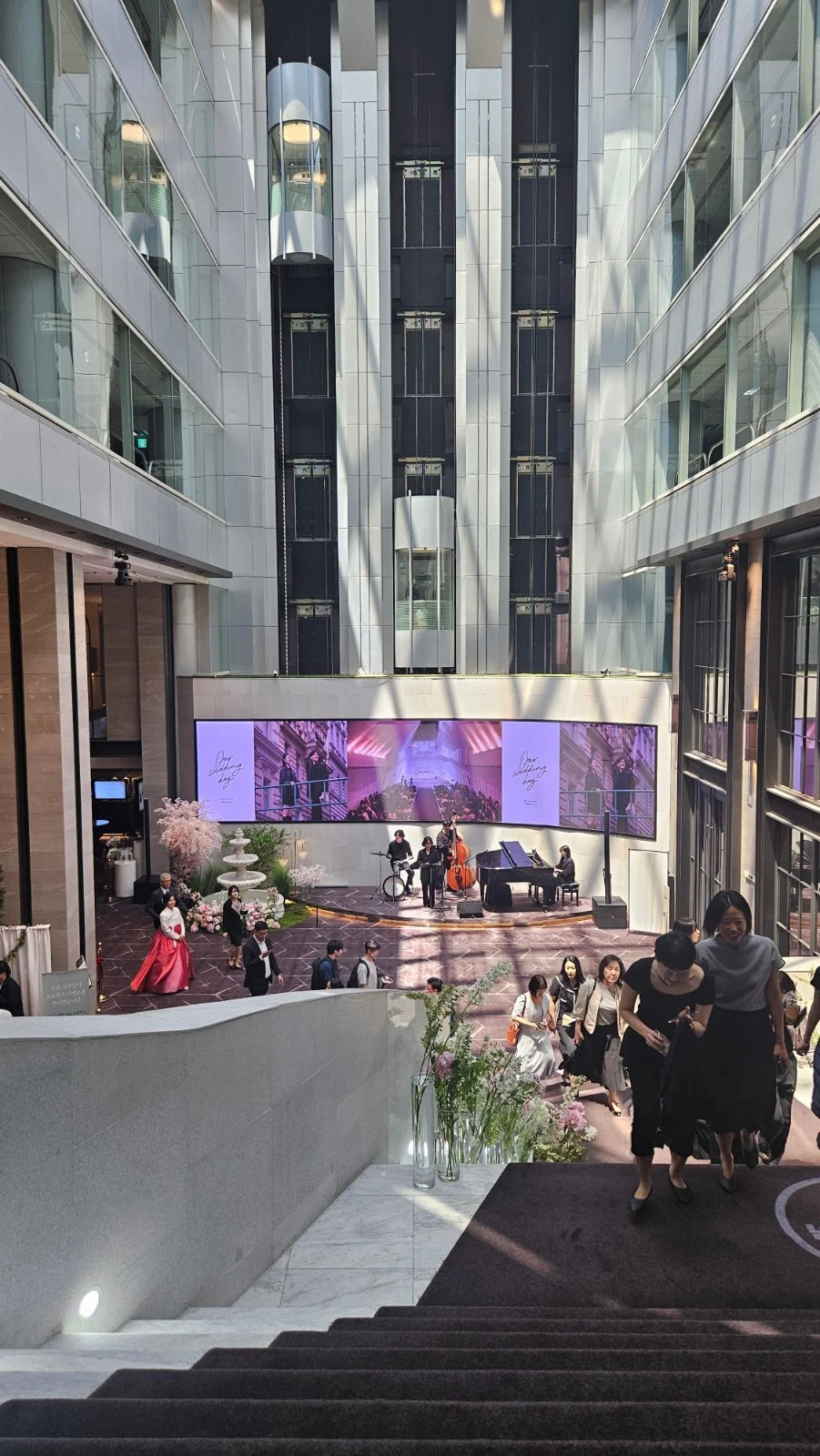
The underground route through COEX, however, was confusing. Before the wedding, we walked from the subway station and photographed the turns and signs along the way. We arranged those images on the directions page in the order guests would encounter them. Closer to the day, we also surfaced the directions in a pop-up so they were easier to find.
We arranged a photo booth separately. It would give people something to enjoy while waiting, a picture to take home, and another way to leave a photo in our guestbook. Many guests used it, though I wished we'd had it for longer than an hour so more people could take part.
We also wanted the photos guests took themselves. A QR code at the venue opened the guestbook form directly, so people could upload pictures without going back through the whole invitation.
Results · What we made, and what people left with us
After the party and wedding, we began collecting moments we hadn't captured ourselves. The website held photos from both occasions, older memories with friends, and messages of congratulations. Party guests posted Instagram Stories, and one person even made a YouTube vlog.
Friends and colleagues overseas left messages when they couldn't be there in person. At a global workshop before the wedding, I gave colleagues invitations printed with a QR code and small gifts. We couldn't see everyone at the ceremony, but the site gave us a way to share the preparations and hear from them.
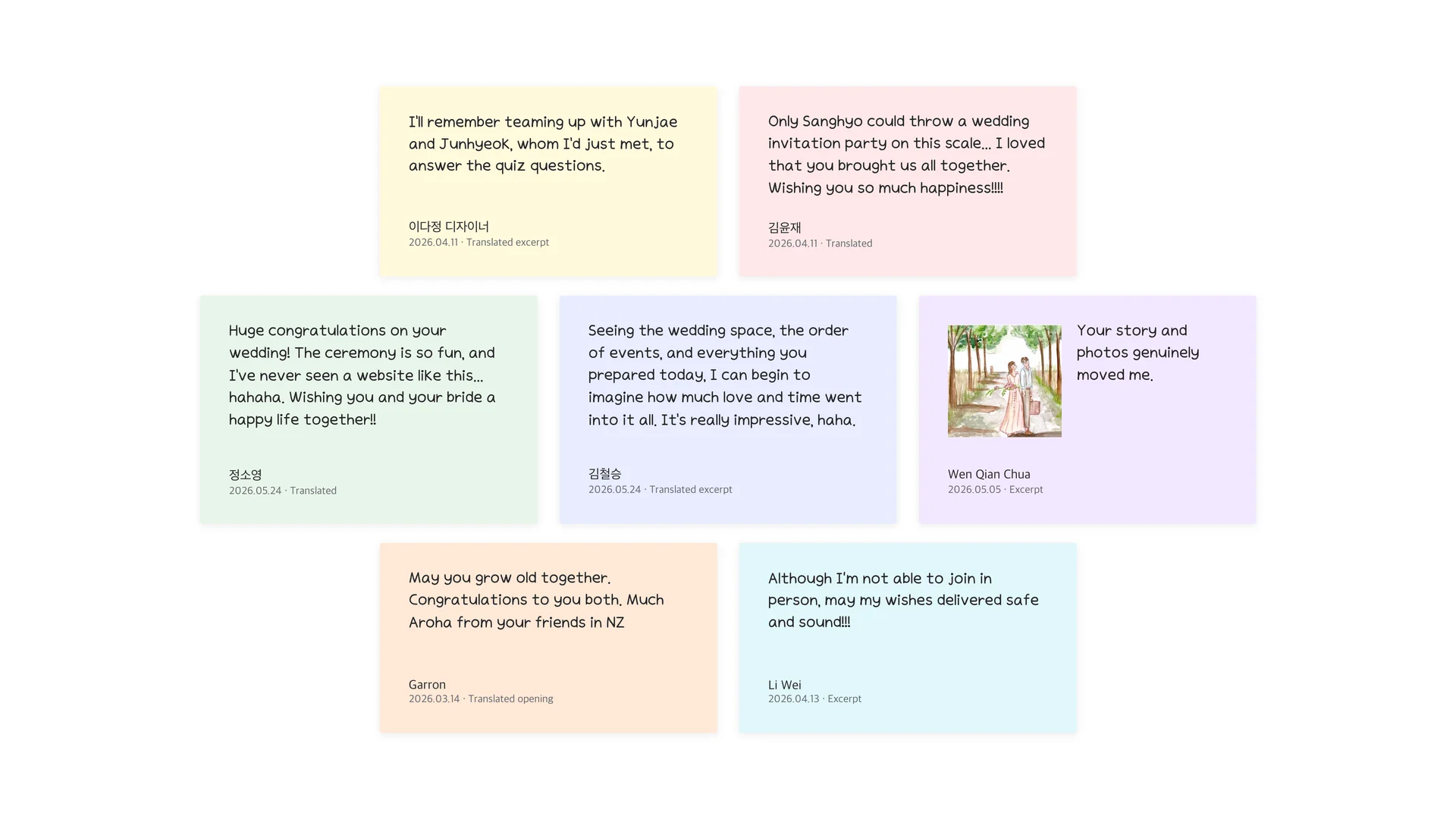
Wen, whom I met through the design community, left a message saying the site's stories and photos had moved them, along with four drawings. These weren't new portraits of us: they shared artwork they had made earlier as a way of celebrating with us. Alongside our own photographs and words, there was now something another person had offered.
Looking back, what stays with me more than any particular written comment is the wit of the MC who helped us through the process and the friend who gave a speech that day. Their words added something our photos and film couldn't have created on their own.
We also kept adjusting what we'd made as we saw people use it. The guestbook needed an example. As the wedding approached, the directions needed to become more prominent. The important question wasn't what else we could build, but what the people in that moment actually needed.
The wedding is over, but the site is still there. A link we first sent to share the news is now one we open to revisit the photos and stories we left together. I'm glad we have a record not just of the day, but of the people we met and the time we spent getting there.