Overview
Two Goals: Demonstrating the Design System and Delivering Product Outcomes
Wanted was introducing projects beyond recruitment as it expanded into a career platform. As a Product & Platform Designer, I worked on a range of these products. Alongside designing for business goals, I actively adopted the design system in each product to support our team's goal of improving both design quality and speed.
Problem
The System Dilemma: More Components, More to Learn
A design system's impact compounds as it is used in the right contexts. As the system matures, however, understanding it takes longer and there is more to learn.
The Familiar Way of Working
As the system evolved, Wanted's design platform team and UX organization grew. More components meant more screens could be built with the system, but also a steeper learning curve for product designers and client developers.
For a designer facing a release the following week, learning component guidelines could take time, and choosing the right component could be confusing. People also tend to prefer familiar workflows. Even with a defined system available, drawing the interface themselves could feel like the better option.
Showing by Examples
Demonstrating How System Proficiency Enables Faster Iteration
Forcing other product makers to use the system could have been counterproductive. Instead, I volunteered to apply my understanding of the system to the products I owned.
- Wanted could test a variety of ideas quickly.
- Developers working on those products became familiar with the system through practical examples.
- Those examples became best practices that helped lower the adoption barrier for other makers.
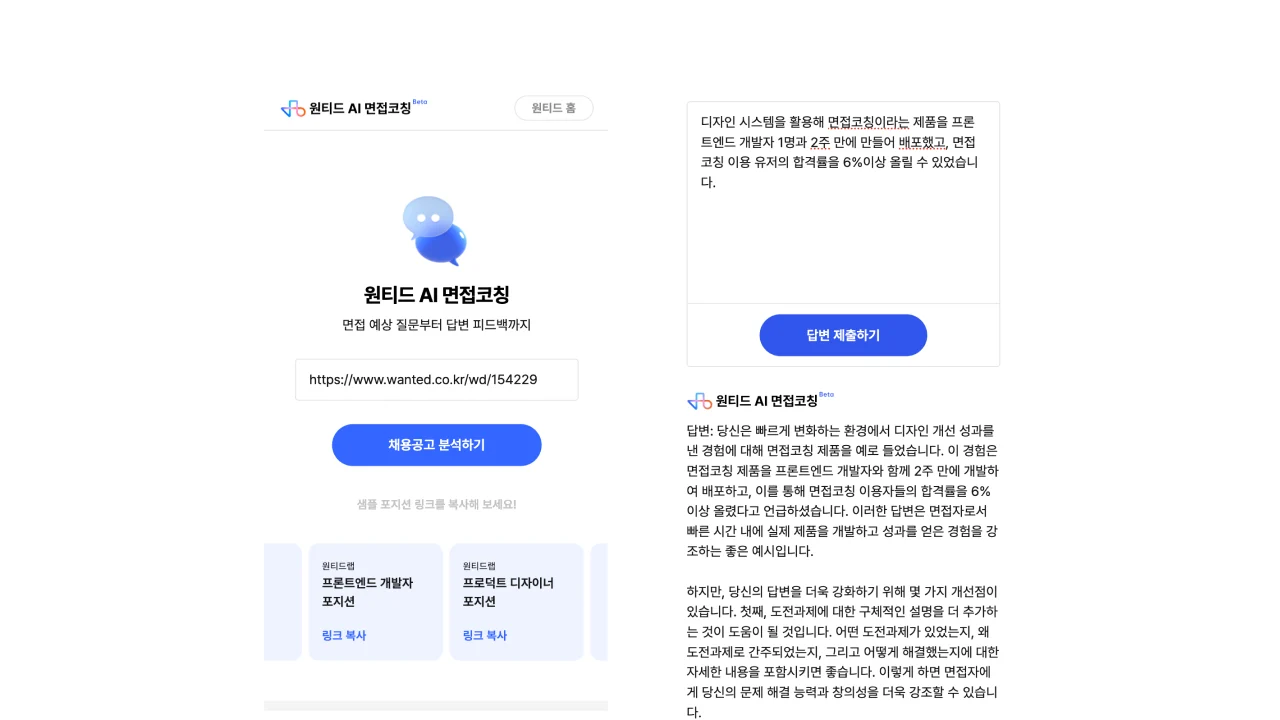
AI Coach for Job Interviews
Salary Lottery for Office Workers

CareerMap
Connecting Career Questions to Real Company Opportunities
CareerMap predicts future career paths based on a user's job family, role, and salary. Many users, however, left after exploring a possible next step because they did not know what to do next. I redesigned the flow to make companies easier to compare and guide users into Wanted's company pages.
- Improve the display logic by defining and mixing Tier 1 and Tier 2 companies in CareerMap.
- Let users compare their current company with a predicted position across perspectives such as pay, growth, stability, and work environment.
After launch, one-third of CareerMap users compared companies across these dimensions, and approximately 17% continued to a recommended company's detail page on Wanted.
Career Mentor
AI Counseling for Job Seekers' Career Concerns
Career Mentor combines information about job seekers with their concerns to offer advice. Users can make better-informed career decisions, while Wanted gains qualitative insights that can inform new projects.
- In the first three weeks, we collected 872 responses without marketing. AI categorized the topics and summarized the concerns.
- Although question presets made it easy to begin, 31.5% of users typed their own questions.
The product surfaced career concerns that quantitative metrics alone could not reveal. Those insights became input for planning other projects. Even without a product owner, we were able to launch on time thanks to the time saved by the design system.
Results
Supporting Design System Adoption across Product Teams
Wanted's design platform team regularly measured system usage by team. By continually sharing practical examples, we helped reduce differences in adoption across the organization.